CWMS RATINGS
Design and Usage Overview
USACE
Hydrologic Engineering Center
11 October 2017
**
Simple ratings specify either rating lookup table or a formula and were introduced in CWMS 2.1.4
ii. USGS-Style Stream Ratings.4
USGS-style stream ratings specify base rating lookup table, stage shift lookup table, and interpolation offset lookup table, and were introduced in CWMS 2.1.4
6. Virtual Rating Source Ratings12
7. Virtual Rating Connections12
a. Connection Strings and Connection Points12
b. Connection Point Ordering and Default Connections12
8. Transitional Rating Selection Criteria17
9. Transitional Rating Source Ratings18
** **Overview. As of CWMS version 2.1, the CWMS Oracle database supports the storage, retrieval, cataloging and deleting of ratings via an application programming interface (API) specified in the CWMS_RATING package. In addition, the API also provides numerous routines to apply ratings. Several views also exist to allow users and developers to easily see the stored ratings. CWMS ratings have one or more independent (input) parameters and a single output (dependent) parameter. Currently the code allows up to nine independent parameters while the views will display up to five independent parameters. CWMS 3.1 adds support for new types of ratings which are constructed from the rating types included in CWMS 2.1.
Rating Types. CWMS supports the following rating types:
Simple Ratings. Simple ratings are defined by either a single lookup table or by a formula. A lookup table is an ordered set rating points. A rating point is a set of values, one for each independent parameter as well as one for the dependent parameter. The dependent value is known when the independent value(s) match a rating point. Various methods are provided to determine the dependent value when the independent value(s) do/does not match a rating point. A formula is a mathematical expression which defines a function of the independent parameter values.
Simple ratings specify either rating lookup table or a formula and were introduced in CWMS 2.1.
USGS-Style Stream Ratings. USGS-style stream ratings are comprised by a single stage/discharge lookup table which defines the base relationship, an optional lookup table of stage/shift rating points which is used to alter the stage before performing the base lookup, and an optional lookup table of stage/offset rating points which is used to modify the logarithmic interpolation between values in the base table.
USGS-style stream ratings specify base rating lookup table, stage shift lookup table, and interpolation offset lookup table, and were introduced in CWMS 2.1.
Virtual Ratings. Virtual ratings are ratings that are assembled by connecting the independent and/or dependent parameters of two or more source ratings in order to create a rating that will perform multiple rating steps in a single API call.
Each source rating may be a reference to another rating in the database or a formula that defines a function of its input values. Source rating formulas are functionally equivalent to source ratings referencing formula-based simple ratings. Formula-based source ratings are often necessary to combine by addition or multiplication the outputs of other source ratings into either the virtual rating output or the input to another source rating.
Virtual ratings specify source ratings and rating parameter connections and were introduced in CWMS 3.1.
Transitional Ratings. Transitional ratings are ratings that compare independent parameter values against selection criteria and evaluate a formula associated with the selected case to determine the dependent parameter values.
The formulas are mathematical expressions that define functions of their input values and/or references to source ratings. Each source rating is a reference to another rating in the database.
Transitional ratings specify selection criteria, mathematical expressions, and source ratings and were introduced in CWMS 3.1.
Specification. CWMS ratings are specified in a hierarchical manner. One or more ratings can share a rating specification, and one or more rating specifications can share a rating template.
Rating Templates. A rating template specifies the independent and dependent parameters and the lookup methods to use for every rating associated with the template (if the rating uses a lookup table). A rating template identifier is comprised of a list of the parameters and a version. The parameters list is a comma-separated list of the one or more independent parameters followed by a semi-colon and the dependent parameter. The version is limited to 32 characters and uniquely identifies the lookup method(s) used with the specified parameter list. A complete rating template identifier is the parameters list followed by a period and the version (e.g., Stage;Flow.USGS-shifted or Count-Conduit_Gates,Opening-Conduit_Gates,Elev-Pool;Flow-Conduit_Gates.Normal).
Parameters. Rating parameters are the same as parameters used in time series identifiers. Each has a base parameter portion which is constrained to the list of valid CWMS base parameters and an optional sub-parameter portion which is unconstrained except for its maximum length of 32 characters. If a parameter includes a sub-parameter, the sub-parameter is separated from the base parameter by the hyphen/dash (-) character. Thus the base parameter Elev can be made more specific by adding a sub-parameter, as in Elev-Tailwater or Elev-Pool.
Lookup methods. Each rating template specifies three lookup methods for each independent parameter: one for the case of the independent value being less than the least independent value in the rating (out of range low), one for the independent value being between the least and greatest independent values in the rating, inclusive (in range), and one for the independent value being greater than the greatest independent value in the rating (out of range high). Only simple ratings with lookup tables use the lookup methods. Valid lookup methods are:
NULL. When specified for out of range low or high method, return NULL for the dependent value when the independent value is out of range. When specified for in range method, return NULL for the dependent value if the independent value does not exactly match an independent value in the rating. For example, when the independent value is a count of gates open, it makes no sense to specify a fractional gate open count, so return NULL.
ERROR. Same as the NULL lookup method, except an exception is raised instead of returning NULL.
LINEAR. When used for an in range method, linearly interpolate both independent and dependent values. When specified as an out of range low or high method, linearly extrapolate both independent and dependent values.
LOGARITHMIC. Same as the LINEAR lookup method, except logarithmic interpolation/extrapolation is used if possible for both independent and dependent values. Linear interpolation/extrapolation is used where logarithmic is not possible.
LIN_LOG. Same as the LOGARITHMIC lookup method except that logarithmic interpolation/extrapolation is performed on the dependent values only. Linear interpolation/extrapolation is used for the independent values.
LOG_LIN. Same as the LOGARITHMIC lookup method except that logarithmic interpolation/extrapolation is performed on the independent values only. Linear interpolation/extrapolation is used for the dependent values.
PREVIOUS. Return the dependent value of the rating point whose position in the rating would immediately precede or be equal to a rating point whose independent value is the value to be rated. Since CWMS ratings are always stored in order of increasing independent values, this method is equivalent to the LOWER lookup method.
NEXT. Return the dependent value of the rating point whose position in the rating would immediately follow or be equal to a rating point whose independent value is the value to be rated. Since CWMS ratings are always stored in order of increasing independent values, this method is equivalent to the HIGHER lookup method.
NEAREST. Return the dependent value of the rating point whose position in the rating is the nearest to a hypothetical point containing the independent value being rated. When specifies as an out of range low method this is equivalent to NEXT. When specified as an out of range high method this is equivalent to PREVIOUS. This is not a valid in range method.
LOWER. Return the dependent value of the rating point that has the greatest independent value that is less than or equal to the independent value to be rated. If no such rating point exists, raise an exception.
HIGHER. Return the dependent value of the rating point that has the least independent value that is greater than or equal to the independent value to be rated. If no such rating point exists, raise an exception.
CLOSEST. Return the dependent value of the rating point whose independent value is closer to the independent value to be rated than any other rating point.
Rating Specifications. A rating specification specifies a location, a rating template, and a set of characteristics. A version identifier labels the set of characteristics associated with the location and rating template. A complete rating specification identifier includes the CWMS location identifier, rating template identifier, and rating specification version separated by the period (.) character (e.g. TULA.Stage;Flow.USGS-shifted.Production, or ARCA.Count-Conduit_Gates,Opening-Conduit_Gates,Elev-Pool;Flow-Conduit_Gates.Normal.Production). The characteristics associated with a rating specification are:
Source Agency. Specifies the agency, company, or organization that is the authoritative source for ratings associated with this rating specification.
Lookup Methods. Each rating specification contains information on how to handle multiple ratings with different effective dates. The lookup methods are the same as specified in 3.a.ii, but the independent value is time and the dependent value is the rated value returned by the various ratings. In this context, out of range low means that the time of the data to be rated is earlier than the earliest effective date of any rating with this rating specification, out of range high means that the time of the data to be rated is later than the latest effective date of any rating with this rating specification, and in range means that the time of the data to be rated is bounded by the earliest and latest effective dates.
Active Flag. If false, no ratings associated with this rating specification will be used to rate data. If false, ratings associated with this rating specification may be used, but note that individual ratings may also be specified as active or inactive.
Auto Update Flag. If true, any automatic ratings update mechanism should load ratings associated with this rating specification into the database as soon as they are available.
Auto Activate Flag. If true, any automatically loaded ratings associated with this rating specification should be marked as active. If false, any automatically loaded ratings associated with this rating specification should be marked as inactive.
Auto Migrate Extension Flag. If true, any automatically loaded ratings associated with this rating specification should have any rating extension present on the next most recent rating applied to the newly loaded rating.
Rounding Specifications. USGS-style rounding criteria strings for each independent parameter, as well as for the dependent parameter. Each rounding specification is a 10 digit string, with the first 9 digits specifying the number of significant digits (not decimal places) the parameter should be rounded to for the magnitude indicated by the digit’s position in the string. The first digit indicates a magnitude of less than .01, and the ninth digit indicates a magnitude of greater than or equal to 100,000. Intermediate digits specify magnitudes of increasing powers of 10 from left to right. The last digit specifies the maximum number of decimal places to be displayed for any magnitude. For example, the rounding specification 2233344332 indicates that values less than 1 should be rounded to 2 significant digits, values of greater to or equal than .1 and less than 100 should be rounded to 3 significant digits, values greater than or equal to 100 and less than 10,000 should be rounded to 4 significant digits, and values greater than or equal t0 10,000 should be rounded to 3 significant digits. For all values, no more than 2 decimal places should be displayed. Ratings downloaded from the National Weather Service NWIS ratings depot include rounding specifications for each parameter.
Description. Descriptive text about the rating specification, limited to 256 characters.
Ratings. A rating contains the data as specified in 2.a that is used to transform the independent parameter values to dependent parameter values. Each rating is associated with a rating specification and has an effective date which identifies it uniquely within the rating specification. In addition to the effective date and the formula or rating points, each rating also contains the following information:
Creation Date. The date and time that the rating was first known. This information is used when performing historical ratings (ratings at a past point in time) to filter out information that was not known at the time. If not specified in the external representation, this field is set to the current time when the rating is loaded into the database. This information is output when ratings are retrieved from the database to preserve the information.
Active Flag. If true, the rating is available for use. If false, the rating will not be used in any rating operation.
Native Units. Specifies the units of the independent and dependent parameters of the external representation.
Description. Descriptive text of the rating, limited to 256 characters.
Time Series of Ratings. As described in the preceding sections, multiple ratings with different effective dates can share a common rating specification which contains lookup methods that determine the behavior of applying the ratings to independent values at a given time. Common in-range methods are PREVIOUS and LINEAR, while PREVIOUS or NEAREST, which have the same effect, are common for out-of-range-high. The out-of-range-low method is commonly NEXT or NEAREST, which have the same effect, or NULL or ERROR.
Specifying LINEAR for an in-range method causes the API to linearly interpolate between the two ratings whose effective times bound the time of the values(s) to be rated. For USGS-style stream ratings, the situation is more complicated. If the time of the value to be rated is on or before the effective date of the latest shift of the previous rating, then the previous rating is used, interpolating the shifts as necessary. If the time of the values to be rated is after the effective date latest shift of the previous rating, then the interpolation occurs in the time span between the effective date of the latest shift of the previous rating and the effective date of the next rating, interpolating flows as necessary.
It is sometimes desirable to transition from one rating to another or from one shift to another on USGS-style ratings over a much shorter time span prior to the new rating or shift than the LINEAR lookup method would provide. This can be accomplished by duplicating the previous rating or shift and setting the effective date of the duplicate to the start of the desired transition time. This will cause the rating to remain constant in the period between the effective dates of the original and duplicate ratings or shifts and to transition linearly between the effective dates of the duplicate and next rating or shift.
Rating Extensions. A USGS-style stream rating may include a separately-specified lookup table of stage/discharge values called a rating extension. A rating extension specifies rating points (extension points) outside the base stage/discharge lookup table and is used to provide historic high (normally) or low stage/discharge values. When a rating with an extension is applied, the base lookup table is first extended above and/or below its specified range by including the appropriate extension points. Any extension points that are within the range of the base rating table are ignored.
Rating Formulas. A formula-based rating specifies a mathematical expression that includes a variable for each of the independent parameters, by position, to be used. The variable name for the first independent parameter is I1, the name for the second is I2, etc…. Negated variables in the format -I1, -I2, etc… are allowed. (ARG1..ARGn, as well as $1..$n are allowed, but generated XML will always have the normalized format of I1..In.) The mathematical expressions may be specified in infix notation (algebraic notation) or postfix notation (reverse polish notation, or RPN). All numbers, variables, operators, and function names must be separated from all others by at least one space, with the exception that no spaces are required adjacent to parentheses (infix notation only, postfix notation does not use parentheses). Mathematical expressions are not case sensitive.
Operators. The following operators are supported. All operators are binary (take two arguments).
+ addition
- subtraction
* multiplication
/ division
// integer division
% modulus
^ exponentiation
Functions. The following functions are supported. All functions are unary (take one argument).
ABS absolute value
ACOS arc cosine
ASIN arc sine
ATAN arc tangent
CEIL ceiling – smallest integer greater than or equal to argument
COS cosine
EXP exponent – e raised to the power of the argument
FLOOR floor – largest integer less than or equal to argument
INV inverse
LN natural logarithm – logarithm base e
LOG logarithm base 10
NEG negation
ROUND round to nearest integer
SIGN signum – sign of argument returned as -1, 0, or 1
SIN sine
SQRT square root
TAN tangent
TRUNC truncation – integer portion of argument
Constants. The following constants are supported.
PI the ratio of a circle’s circumference to its diameter
E Euler’s number – the base of the natural logarithm
Example. Assume we need to use the formula \(Q = C_{s}Lh_{s}\sqrt{2gh}\) to compute the flow through submerged gates. Given the following definitions and independent parameters, the mathematical expressions would be as shown.
Definitions:
\(C_{s}\) = submerged gate coefficient
\(L\) = 60.0 ft
\(h\) = pool elevation – tail water elevation in feet
\(h_{s}\) = tailwater elevation in feet - sill elevation (506.0 ft)
\(g\) = acceleration due to gravity (32.2 ft/sec2)
Parameters:
Independent parameter 1: Elev-Pool
Independent parameter 2: Elev-Tailwater
Independent parameter 3: Coeff-Gate-Submerged
Native Units:
Native units for the rating would be ft, ft, n/a, and cfs. Other units could be specified and/or requested and the rating procedure would handle the unit conversions, ensuring the appropriate units are used with the formula.
Expressions:
Infix (Algebraic):
I3 * 60 * (I2 - 506) * SQRT(64.4 * (I2 - I1))
Postfix (RPN):
I2 I1 - 64.4 * SQRT I2 506 - * 60 * I3 *
Virtual Rating Source Ratings. Source ratings specified in virtual ratings may be rating specification identifiers or formulas. Rating specification identifiers must be for the same location as for the virtual rating. Formulas have the same format specified in Section 5.
Virtual Rating Connections. Virtual ratings specify how the independent parameters are connected to the source ratings and how the independent and/or dependent parameters of the source ratings are connected to each other.
Connection Strings and Connection Points. A virtual rating connection string is a comma-separated string of individual connections. Each individual connection is two different connection points separated by an equals sign (=). Connection points are comprised of the set of all independent parameters to the virtual rating plus all independent parameters of each source rating plus all dependent parameters of each source rating. Connection points are of the following formats. Note that ‘I’ is upper case ‘i’, not lower case ‘L’.
- In – Input independent parameter n, referencing the
independent parameters of the virtual rating. Independent parameters are ordered by their position in the parameters identifier in the rating template. Connection point I2 specifies the 2nd independent parameter of the virtual rating.
- RmIn – Source rating m independent parameter n.
Connection point R1I2 specifies the 2nd independent parameter of the 1st source rating.
- RmD – Source rating m dependent parameter. Connection point
R2D specifies the dependent parameter of the 2nd source rating.
Example connection strings:
R1I1=R2I1
R1D=R3I1,R2D=R3I2
R2I1=I1,R2I2=R1D,R3I1=R2D
Connection Point Ordering and Default Connections. Source rating connection points are ordered first by the position of the source rating and then the position of the independent parameter to that rating, with the dependent parameter of any source rating ordered after the last independent parameter of that same source rating. For example “R2D” would sort after “R2I3” and before “R3I1”.
At least one of the source rating connection points must be left unspecified in the connections string. The maximum number of source rating connection points that may be left unspecified is one greater than the number of independent parameters of the virtual rating. The last (or only) unspecified source rating connection point – according to the order specified above – is the dependent parameter for the virtual rating. Any additional unspecified source rating connection points are by default connected to the independent parameters of the virtual rating in order (i.e., I1 is connected to the first unspecified source rating connection point, I2 is connected to the second one, etc…). All source rating connection points that are connected to independent parameters of the virtual rating may be specified for clarity; only the source rating connection point connected to the dependent parameter of the virtual rating is required to remain unspecified.
**
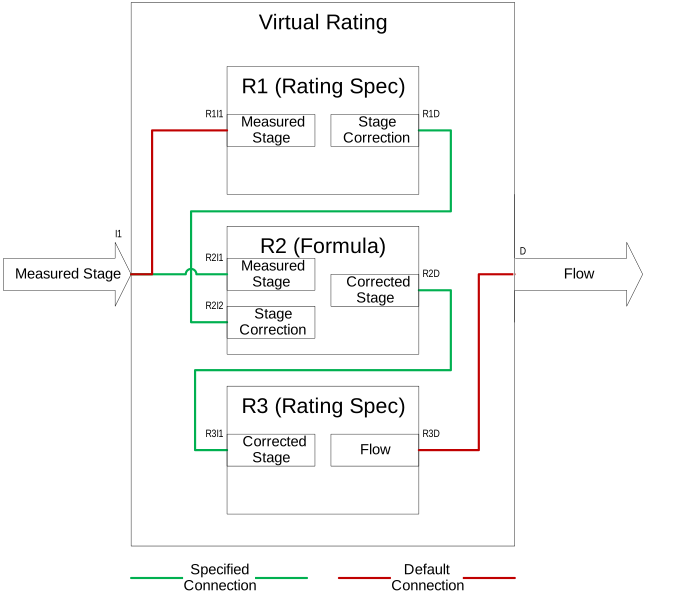
Example 1. Consider a virtual rating with one independent parameter – measured stage – and a dependent parameter of flow with the following source ratings and connections string:
R1 is a rating with an independent parameter of measured stage and a dependent parameter of stage correction.
R2 is a formula which adds its 1st input – measured stage – to its 2nd input – stage correction – to generate an output of corrected stage.
R3 is a rating with an independent parameter of corrected stage and an dependent parameter of flow.
The connection string is R2I1=I1,R2I2=R1D,R3I1=R2D
The source rating connection points R1D, R2I1, R2I2, R2D, and R3I1 are all specified in the connection string, leaving the source rating connection points R1I1 and R3D unspecified. The last unspecified source rating connection point in order, R3D, becomes the dependent parameter for the source rating, and R1I1 is connected by default to I1.
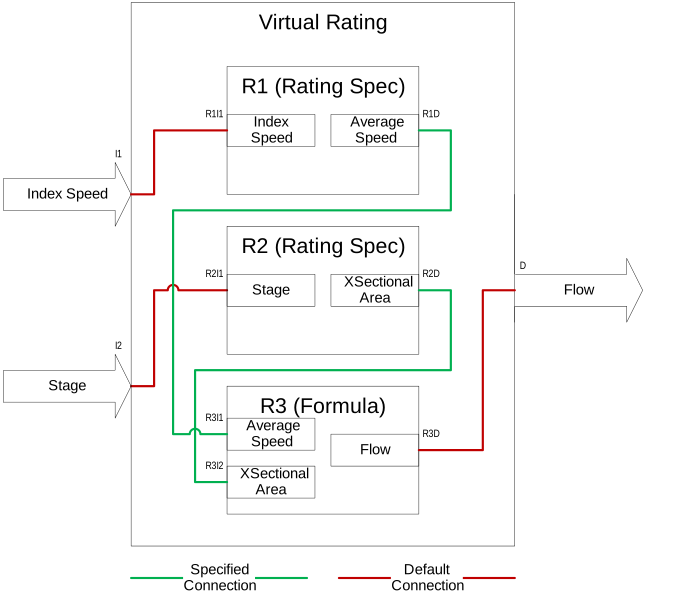
Example 2. Consider a virtual rating with independent parameters of index velocity and stage and a dependent parameter of flow with the following source ratings and connections string:
R1 is a rating with an independent parameter of index speed and a dependent parameter of stage correction.
R2 is a rating with an independent parameter of stage and an dependent parameter of cross-sectional area.
R3 is a formula which multiplies its 1st input – average speed – to its 2nd input – cross-sectional area – to generate an output of flow.
The connection string is R1D=R3I1,R2D=R3I2
The source rating connection points R1D, R2D, R3I1, and R3I3 are all specified in the connection string, leaving the source rating connection points R1I1, R2I1 and R3D unspecified. The last unspecified source rating connection point in order, R3D, becomes the dependent parameter for the source rating, while R1I1 and R2I1 are connected by default to I1 and I2, respectively.
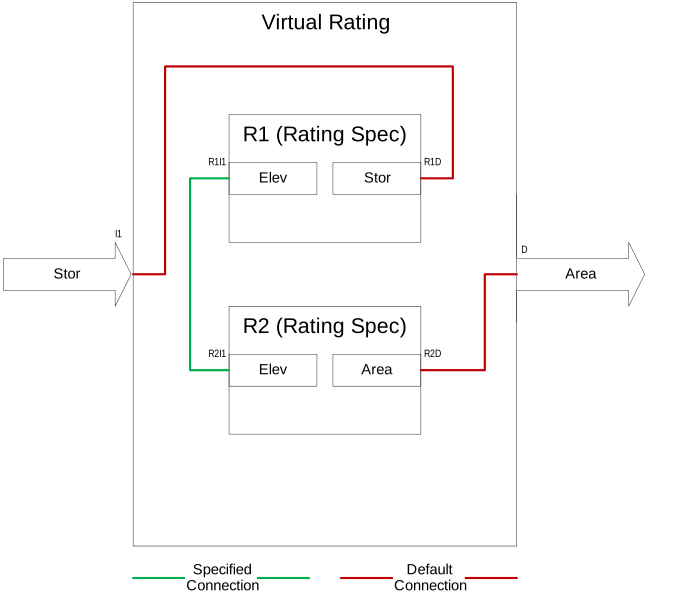
Example 3. Consider a virtual rating with an independent parameter of reservoir storage and a dependent parameter of surface with the following source ratings and connections string:
R1 is a rating with an independent parameter of reservoir elevation and a dependent parameter of storage.
R2 is a rating with an independent parameter of reservoir elevation and a dependent parameter of surface area.
The connection string is R1I1=R2I1
The source rating connection points R1I1 and R2I1 are both specified in the connection string, leaving the source rating connection points R1D and R2D unspecified. The last unspecified source rating connection point in order, R2D, becomes the dependent parameter for the source rating, while R1D is connected by default to I1.
Transitional Rating Selection Criteria. Transitional rating selection criteria are comprised of an ordered list of zero or more logical expressions, with an evaluation associated with each expression, followed by a default evaluation. The logical expressions are tested in order, using the current set of independent parameter values. If an expression yields “True” when tested, then the evaluation associated with that expression is performed to generate the dependent parameter value for the transitional rating and the selection process ceases. If none of the expressions yield “True” when tested, then the default evaluation is performed to generate the dependent parameter value for the transitional rating.
Logical Expressions. Logical expressions are expressions that evaluate to True or False. They are comprised of mathematical expressions (see Section 5) combined with the following comparison and combination operators:
Op erat or |
Class |
Description |
||
|---|---|---|---|---|
= |
EQ |
comparator |
equal to |
|
!= |
<> |
NE |
comparator |
not equal to |
> |
GT |
comparator |
greater than |
|
>= |
GE |
comparator |
greater than or equal to |
|
< |
LT |
comparator |
less than |
|
<= |
LE |
comparator |
less than or equal to |
|
AND |
combinator |
conjunction |
||
OR |
combinator |
disjunction (inclusive) |
||
XOR |
combinator |
disjunction (exclusive) |
||
NOT |
combinator |
negation |
Logical expressions may be specified in infix (algebraic) or postfix (RPN) notation, but notations may not be mixed in the same expression.
I3 < 11.1 AND I1 – I2 < 7.5 correct (infix)
I3 11.1 < I1 I2 – 7.5 < AND correct (postfix)
I3 < 11.1 AND I1 I2 – 7.5 < incorrect (mixed notation)
If multiple combinators are included in infix notation, attention must be paid to operator precedence: NOT, AND, XOR, OR. NOT has the highest precedence and so binds the most tightly to its argument; OR has the lowest precedence and so binds the least tightly to its arguments. Parentheses may be used to alter the order of operations. All mathematical operators have higher precedence than any comparison operator, and all comparison operators have higher precedence than any combination operator.
Evaluations. Each evaluation is a formula as defined in Section 5, with the addition of the term Rn which references the dependent parameter value of source rating n (e.g., R1 references the dependent parameter value of source rating 1) using the current set of input parameter values. Source rating terms may be included in larger evaluation formulas; they may also be the only term in an evaluation, specifying that the source rating is the evaluation.
Transitional Rating Source Ratings. Source ratings in transitional ratings are specified as rating specification identifiers. Each source rating must be for the same location as the transitional rating and must also have the same parameters identifier.
External Representation. The external representations of rating templates, rating specifications, and ratings that are handled by the CWMS_RATING package for storage and retrieval is an XML format formally described in the XML schema document http://www.hec.usace.army.mil/xmlSchema/cwms/Ratings.xsd, which is documented at http://www.hec.usace.army.mil/xmlSchema/cwms/Ratings.htm. The document root is “ratings”, and may include zero or more “rating-template” elements followed by zero or more “rating-spec” elements, followed by zero or more “simple-rating”, “usgs-stream-rating”, “virtual-rating”, and/or “transitional-rating” elements, in that order.
API. The CWMS Database API provides routines for storing, retrieving, cataloging and deleting rating templates, rating specifications, and ratings. It also provides routines for applying ratings in various manners. See the following items in the CWMS Database API documentation:
CWMS_RATING package
CWMS_V_RATING view
CWMS_V_RATING_LOCAL view
CWMS_V_RATING_SPEC view
CWMS_V_RATING_TEMPLATE view
CWMS_V_RATING_VALUES view
CWMS_V_RATING_VALUES_NATIVE view
CWMS_V_TRANSITIONAL_RATING view
CWMS_V_VIRTUAL_RATING view